
TANGENTIAL FILTRATION FHDS
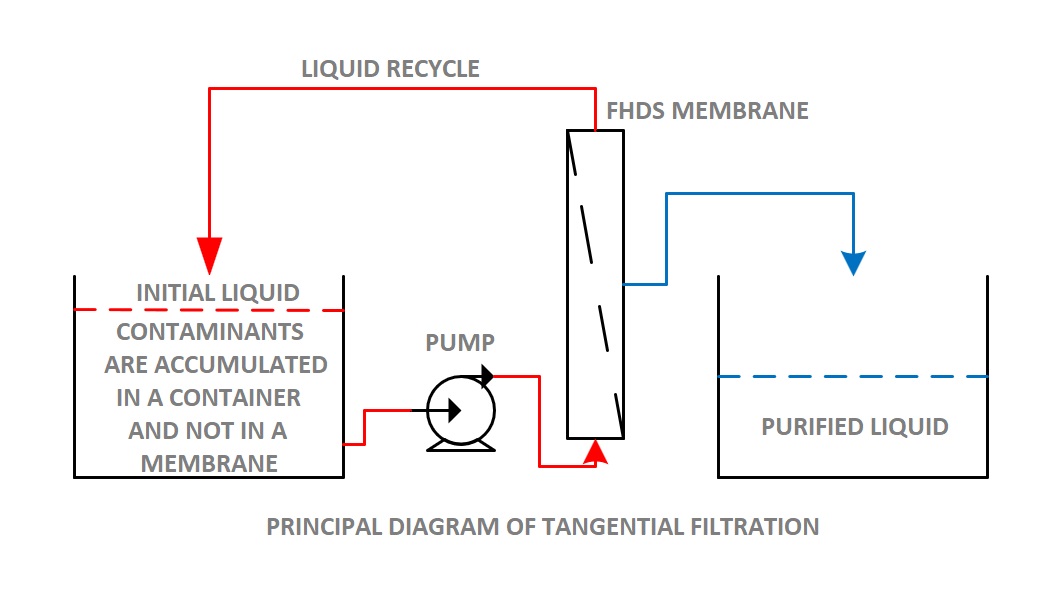
Tangential filtration is a technology that simultaneously filters liquid and thickens sediment. This happens due to the circulation of the solution to be purified in the tank through the FHDS membrane. The diagram shows a pump connected to the container of the solution to be purified; it directs the fluid flow to the membrane unit, inside which the solution passes along the filter fibers at a given speed and returns to the original container. Filtration takes place at a pressure not exceeding 0.2 MPa.
During operation, the following indicators are monitored :
· main flow pressure at the outlet of the membrane
· flow rate of the cleaned stream
· capacity by filtered solution
· density of the treated solution at the end of filtration
· filter cycle time
· condition of the filtrate (through a sight pipe)
The
solution that passed through the membrane enters the container for the purified
product, while the contaminants themselves accumulate not on the surface of the
membrane, but in the original container.
Unlike dead-end filtration,
FHDS technology allows filtration to continue without frequent stops to flush
or change filters. Due to the fact that solid particles move at high speed
along the membrane fibers, the membrane surface is self-cleaning, the particles
do not have time to attach to the fiber, they are pushed by those following
them. This effect significantly increases the filter cycle of the technology,
reducing the frequency of flushing, and therefore reduces the load on the
drainage system and discharge.