
INSTANT BIODIESEL PRODUCTION
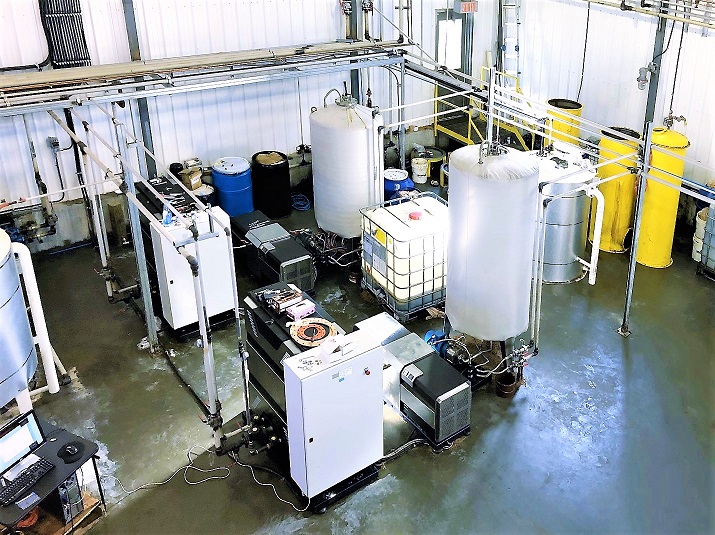
The Novasvit company has developed a technology that, in flow mode (in just a few seconds), makes it possible to produce high-quality biodiesel fuel from any type of vegetable oil (including waste oil), as well as animal fats.
The production process is very simple: a mixture of vegetable oil and methanol in the presence of an alkaline catalyst enters the reactor from one side, and the finished biodiesel fuel flows out from the opposite side of the reactor after 7-8 seconds.
Existing methods of obtaining biodiesel - a brief overview
Classic technologies that are used all over the world today have a number of significant disadvantages:
- the process is multi-step
- strongly depends on the quality of raw materials
- requires high temperature and high pressure
- excessive energy consumption (100 – 120 kW per 1 ton of biodiesel fuel)
- requires more chemical reagents
- too much time spent (the total duration of the process is 6 hours)
Flow technology of the Novasvit company
To obtain biodiesel, a certain amount of oil is mixed with the required amount of methanol, plus a catalyst. As a result of the chemical reaction, the main product - biodiesel (methyl ether) is formed, as well as - glycerin - a valuable component that is widely used in pharmaceutical, paint and other industries. The obtained biodiesel is characterized by good starting ability for the engine, high cetane (octane) number.
If the cetane (octane) number for mineral diesel fuel is usually 42-45, then in biodiesel fuel it is about 51. This allows it to be used in diesel engines without the addition of substances that stimulate ignition.
Raw materials for the production of biodiesel fuel:
- Various vegetable oils: sunflower, soybean, palm, cotton, linseed, coconut, corn, mustard, peanut, castor, hemp, etc.
- Spent and substandard oils of vegetable origin
- Animal fats
- Methanol
- The catalyst is alkaline
Our technology has the following advantages:
- low electricity consumption (the production of 1 liter of biodiesel takes no more than 0.005 kW, which is many times less than existing technologies)
- instantaneous reaction of converting components to fuel
- the technological module is quite compact, in fact the reactor occupies an area of 3-5 square meters (excluding the storage tank), it is easy to transport and install
- the quality of the produced biodiesel meets international norms and standards, in particular the European standard EN14214
- no waste, as a by-product after the production of biodiesel - glycerin is used in many industrial fields
- no "drying" of biodiesel is required, as methanol is recovered
- A continuous reactor, this will allow to increase the speed and quality of the course of the reaction of the conversion of components to fuel, thereby increasing not only the qualitative, but also the quantitative indicators of the output of pure biodiesel fuel. The speed of production makes it possible to save energy resources by 5-7 times compared to existing technologies
- the equipment is distinguished by its ease of operation and high productivity (the productivity of one standard module is 3 tons of biodiesel fuel per hour)
- work on the installation does not require any special skills for personnel
Analysis of the received fuel at the European Quality Center:
- Complex esters - 98.3% (m/m)
- Flash point - 157 degree C
- Viscosity at 40 C - 4.71 mm2
- Phosphorus content - 2.12 mg/kg
- Methyl., linoleum ether., k-ty - 7.9% (m/m)
- Methanol content - 0.14% (m/m)
- The content of monoglycerides - 0.78% (m/m)
- Content of diglycerides - 0.2% (m/m)
- Triglyceride content - 0.2% (m/m)
- Free glycerin - 0.02% (m/m)
- Total glycerin - 0.25% (m/m)
- Alkali metals (Na + K) - 0.01 mg/kg